If you've been tracking every calorie and the scale still won't move, you're not alone, and you're not doing it wrong. Counting calories just isn't the whole picture.
Here's my point up front: don't focus on tracking calories. Learn to balance the right foods on your plate, and weight loss becomes a byproduct. At CSH Fitness we teach clients to build a healthy plate split into thirds: 1/3 protein, 1/3 veggies and 1/3 energy (carbs and fat).
In my career as a coach, I have never had a weight loss client come to me overeating calories. Almost every weight loss client I've worked with was overweight and under-eating, and almost every one believed they were eating too much. Below I'll explain how your body uses food, why calorie counting falls short, and exactly how to build your plate.
The healthy plate: 1/3 protein · 1/3 veggies · 1/3 energy (carbs + healthy fats). Aim for 3–4 balanced plates a day, and strength train so your body uses that fuel to build muscle.
Why "calories in, calories out" is a flawed model
Weight loss isn't as simple as eating less than you burn. The calories in, calories out model ignores the hormones and chemical pathways that decide what your body does with the food you eat.
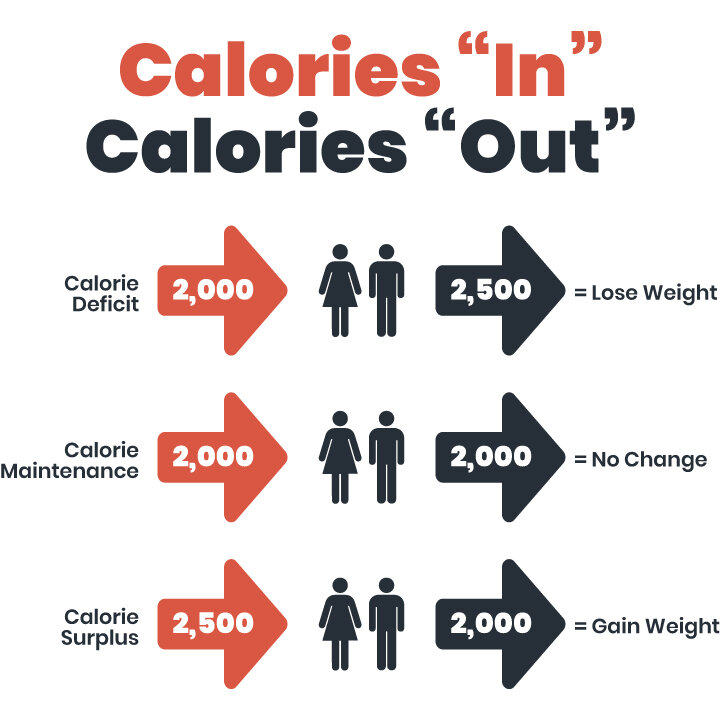
Picture your body as a car. Your cells are the engine, your fat stores are the gas tank, and food is the fuel. The calorie model says that to empty the tank, you either put in less fuel (eat less) or drive more (exercise more).
A real engine needs much more than fuel. It needs the right mix of fuel and air, a well-timed spark, the right temperature, oil and more. Throw any of those off and the engine burns fuel badly, if it runs at all. Your body works the same way. A clogged air filter or low oil is like a hormone imbalance: the fuel is there, but it can't be used efficiently.
Different foods, and different combinations of foods, trigger different hormonal responses. Those hormones decide whether the food you eat gets burned, used to build muscle or stored as fat.
What your body needs from food: protein, carbs, fat and micronutrients
Your body needs three macronutrients in balance (protein, carbohydrates and fat) plus vitamins and minerals. If you only count calories, you could eat almost all of one macronutrient and still hit your number. That gives you a poorly running car. Why would you expect a broken car to lose weight?
Protein: build muscle and recover
Protein you eat is broken down into amino acids. Your body uses them to:
Build and repair tissue, make hormones and enzymes, and support your immune system. In other words, build muscle and stay healthy.
Fuel energy when needed. Carbs are your body's first choice for energy, but protein can be used too.
Make other compounds your body needs.
Your body uses 20 amino acids. Nine of them are essential, which means they have to come from food. Animal proteins contain all of them. Most plant sources are incomplete on their own, but eating a variety of plant proteins covers them.
Why it matters for weight loss: protein lets you build muscle. Eating for fat loss while strength training raises your metabolism, so you burn more at rest and it gets easier to carry less body fat. That's why protein gets 1/3 of the healthy plate.

Carbohydrates: your main energy source
Carbs are broken down into glucose in your bloodstream. You use that glucose for energy, and your body stores some as glycogen in your liver and muscles. Think of your glycogen stores as cups. Once the cups are full, extra glucose spills over and is stored in your fat cells.
Fiber, the carbohydrate in fruits and vegetables that you can't digest, doesn't give you energy, but it keeps digestion healthy and helps your body remove waste.
Carbs fuel your daily activities, your brain and your workouts, which is where the muscle that protein builds comes from. Carbs share the "energy" third of your plate with fat.

Veggies: fiber that keeps blood sugar in check
Vegetables are your main fiber source. Fiber slows digestion and helps manage the insulin response that rises with blood sugar. When insulin is high, your body favors storing energy over burning stored fat. That's why veggies get the last 1/3 of your plate.
Fats: essential, not the enemy
Fat is a secondary energy source, and your body needs it to:
Supply fatty acids it can't make on its own, like omega-3s
Absorb vitamins A, D, E and K
Store energy, insulate you, protect your organs and help hormones and proteins do their jobs
Dietary fat comes in three main types:
Saturated: meat, butter and cream
Unsaturated: olive oil, avocados, nuts and canola oil
Trans fats: commercial baked goods, fast food and some margarines. Limit these.
Fats share the energy third of your plate with carbs.

Micronutrients: eat the rainbow
Vitamins and minerals drive energy production, immune function, bone health, fluid balance and more. Many aren't stored in your body, so you need them from food every day. The easiest way to cover them is to make your plate as colorful as possible.
Why most diets fail
Most diets fail for three reasons: your metabolism, your hormones and your brain. Your body evolved to survive food shortages, so it holds on to energy when it senses scarcity.
Metabolism: when you simply eat less, your body lowers your resting metabolic rate and uses energy more efficiently, so you burn fewer calories a day.
Hormones: under-eating changes the hormones that control hunger and fat storage.
Brain: calorie restriction increases activity in the parts of your brain tied to food reward and motivation. You become fixated on food, which makes regaining weight more likely.
How to build a healthy plate (instead of counting calories)
At CSH Fitness we believe the key is balancing your plate so your body gets the right fuel. When it does, your hormones help you naturally regulate how much you eat. Focus on 3–4 healthy plates a day and weight loss becomes the byproduct.
Divide every plate into three sections:
1/3 protein: chicken, fish, lean beef, eggs, Greek yogurt or plant proteins
1/3 veggies: as colorful as possible
1/3 energy: carbs and healthy fats together
Want the full approach, including protein, sleep and strength training? Read How to Lose Weight Without Crash Dieting.
Some people need a more individualized approach, and that's normal. Our coaches are ready to help clients work through any roadblocks along the way.
Track your progress with more than the scale
When you eat to fuel muscle and you strength train, the scale can be misleading. You may lose fat and gain muscle at the same time. That's why our clients track progress with a free InBody body composition scan, which shows muscle, body fat and body water, not just weight.
Keep reading:
Frequently asked questions
Can you lose weight without counting calories?
Yes. At CSH Fitness we teach clients to build balanced plates (1/3 protein, 1/3 veggies, 1/3 carbs and healthy fats) 3–4 times a day, paired with strength training. When your body gets the right fuel, weight loss becomes a byproduct.
What is the healthy plate method?
Divide your plate into thirds: one third protein, one third vegetables, and one third energy from carbohydrates and healthy fats. Make it as colorful as possible to cover your vitamins and minerals.
Why do most diets fail?
Eating too little lowers your resting metabolism, changes the hormones that control hunger and fat storage, and makes your brain more focused on food. Those changes make weight regain more likely.
Why is protein important for weight loss?
Protein helps you build and keep muscle. Strength training while eating enough protein raises your metabolism, so you burn more energy at rest.
How do I know if I'm losing fat and not muscle?
A body composition scan like InBody measures muscle, body fat and body water separately. CSH Fitness includes a free InBody scan with every free fitness assessment in Winter Garden and Minneola.
Want a coach to build your plan? We offer private, one-on-one personal training in Winter Garden and Minneola, with nutrition coaching and InBody scans included. Start with a free fitness assessment.
Disclaimer: The information on this site is intended to provide general educational information only, and does not constitute, nor is it a substitute for, medical advice.